

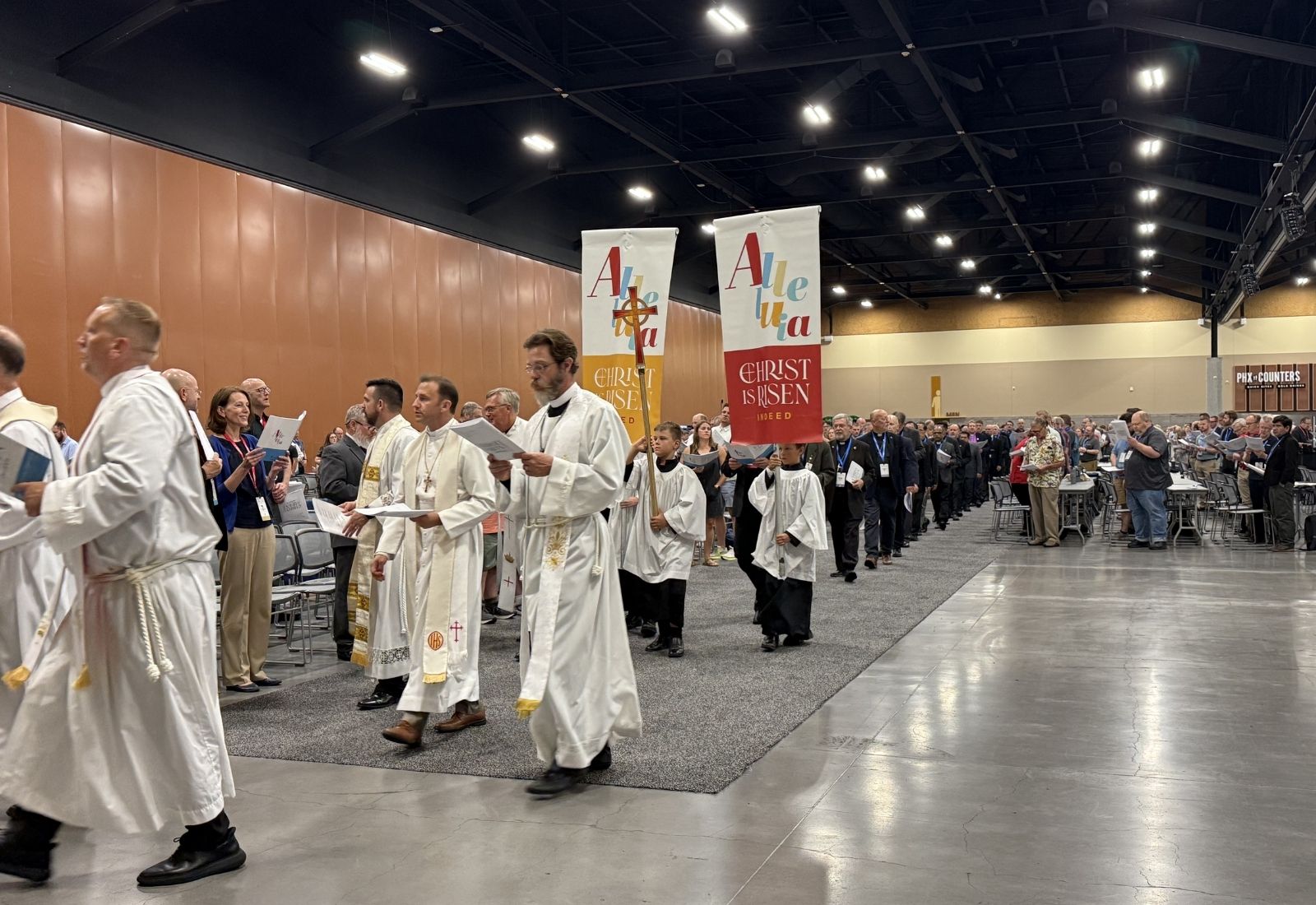
Christ Is Risen Indeed – Day 1 of the LCMS National Convention
Saturday, July 18
Contributed by Pastor Steve Heinsen
Northwest District Secretary
Phoenix, Arizona, is nationally known for several things. Wonderful winters. Blistering hot summers. Dry desert air. World-class hiking in the area including Camelback Mountain and South Mountain Park. Arts and culture such as the Heard Museum and the Desert Botanical Garden. Spring training for Major League Baseball in what they call the Cactus League. The Arizona Diamondbacks playing Major League Baseball at Chase Field. A number of the delegates, myself included, went to a game last night at Chase Field against the St. Louis Cardinals. How ironic to have the Cardinals in town just in time for the Synod Convention! Fantastic Sonoran-Mexican food such as delicious street tacos. Phoenix is an area I have come to know well over the past fifteen years. In 14 of those years (with a one-year break for COVID), I have been to all the Best Practices conferences at Christ Church Lutheran not far from the downtown area. I’ve also made time on these trips every February to go hiking in the Superstition Mountains to the east of the metro area, and use Phoenix as a base to explore most of the state of Arizona (Tucson, the Grand Canyon, Flagstaff, and the Petrified National Forest, among many other sites).
But for the Northwest District delegates heading south for the 69th Convention of the Lutheran Church – Missouri Synod, the Phoenix Convention Center in downtown Phoenix was the main gathering place. Many of the delegates arrived Friday afternoon and evening. After a good night’s sleep, activities began bright and early this morning. It was time to formally register and explore the Center. This convention is a reunion of sorts, as old friends and classmates that had not been seen for years met up. There is also a large hall set up for exhibits from many service agencies, universities, and the two seminaries that serve our Synod.
Beginning at 8:30 a.m., open hearings from the 10 committees established for this convention began. These open meetings provide an opportunity for anyone to have up to five minutes to share their thoughts on resolutions that committee members had put together. Some of the meetings were standing room only. I went to three of these meetings.
I began the day with Floor Committee #6 – Pastoral Ministry and Seminaries. The room for this meeting only had seating for about 60 people. It was standing room only with close to 100 people present. One of the major issues here dealt with Resolutions 6-06 through 6-08, all of which dealt with Specific Ministry Pastor Program. Caution was urged in making major changes to the program by several presenters, as the program is seen in many places as being effective in reaching people both who are followers of Jesus and those who do not yet follow Him. A significant concern was why Specific Ministry Pastor applicants had to be 40 years old to be considered for the program. Several presenters shared that any age restrictions should be consistent across the board (Master of Divinity, Colloquy, Ethnic Immigrant Institute of Theology, and Specific Ministry Pastor). Several presenters asked, “Why are we painting ourselves into a corner by adding more restrictions?”
Several people presented on Resolution 6-04 – “To Support Residential Master of Divinity and Alternate Route Pastoral Formation for the Sake of the Flock.” There is strong support of the residential model of ministry preparation. However, some stressed a desire to be open to other models of training. A section of the Whereas’ mentioning that “Ministers of Christ must be prepared to go where they ‘do not want to go’ (John 21:18) followed by “and those incapable of doing such are not fit for the ministerial work,” was a source of concern, being seen as too condemnatory. This is a Floor Committee that will garner much discussion time on the floor of the convention in a few days.
My next stop was at Floor Committee #7 – University Education. The earlier session for this committee had a standing room only crowd. By the time I arrived for the beginning of the second session, the room was a bit over half full. Some of the key topics addressed by this committee included the prior approval process for university theological faculty and university presidents, worship practices on Concordia University campuses, a clarification of what “Lutheran identity” encompasses, and recommendations on the future status of the Concordia University system.
Two resolutions drew the most attention. Resolution 7-08 – “To Study Synodwide Corporate Status of Concordia University System” was spoken to by several Concordia University presidents. Portions of that resolution, according to those presidents, had been put together by the floor committee without direct consultation with the universities’ Boards of Directors or the Presidents. Those groups had received about one week’s notice of what was in the resolutions to determine costs and impacts to their universities. Concern about due diligence was expressed.
Resolutions 7-04 – “To Clarify Prior Approval Protocols for University Theological Faculties” and 7-05 – “To Clarify Prior Approval Protocols for University Presidential Candidates” addressed the prior approval process. Currently, candidates can be rejected for consideration for those positions without a reason being offered for their rejection. It was stressed that offering a reason why a name was rejected could lead to greater unity in our Synod. The Concordia University System President explained the specifics of why not everyone is given a reason. Some of it has to do with the structure of the process. Another reason has been protecting people’s reputation.
I had about 30 minutes left in the two morning sessions to sit in on part of the meeting for Floor Committee #5 – Theology and Church Relations. It was filled to the max with people all the way outside the doors of the room. While I had missed over two hours of earlier discussion, it quickly became obvious that two resolutions were the main topic. Resolution 5-08 – “To Reaffirm the Synod’s Positions On Men and Women in the Church” and Resolution 5-09 “To Address The Public Reading of Scriptures” drew much discussion. These will definitely be hot topics on the floor of the convention.
At 1:30 p.m., all the delegates met in Halls A and B on the third floor of the Phoenix Convention Center for an orientation. Instructions were given on the ins and outs of how the convention would operate. At 5 p.m., delegates enjoyed a banquet in the Ballroom. At 7:30 p.m., everyone met back in the main convention hall for Divine Worship with Holy Communion. More than 2,000 worshippers, voting and advisory delegates, pastors, musicians, officials, church workers, laypeople, staff, and guests gathered to worship the Lord. The gifts came this evening through His Word and receiving the blessing of the Lord’s Supper. Divine Service 2 from the Lutheran Service Book was followed for worship. In addition to a brass choir, a children’s choir with students from several congregations around the country added elegance to the service. The readings for the evening were taken from the Easter Vigil and the Resurrection of our Lord services. President-Elect Reverend Doctor Matthew Harrison preached from 1 Corinthians 15:12-25 with the theme “Christ Is Risen Indeed.”
Tomorrow gets off to an early start. There will be a 6:30 a.m. breakfast meeting for all the Northwest District delegates, as well as the delegates from the California-Nevada-Hawaii and Pacific Southwest Districts, at the Convention Center. The Convention Business begins at 8 a.m. Please continue to pray for the convention itself and the delegates, that we would all be guided by the Holy Spirit in making decisions that are God-pleasing and that focus us on the mission of connecting people to Jesus.